
In commemoration of the first real post on this website, I (Fin) wanted to spend a bit of time giving a retrospective of my development of City of God. This is for the purposes of analysis and ‘lessons learned’ on game design, but also to give a bit of a story of the journey that I’ve been on, why I did what I did, and what I think I’ve learned from it – and others could learn from it to.
Where do ideas come from?
About a month ago I did an interview (hosted by the excellent Ben Walker), where I was asked why I made City of God. The honest answer is I don’t really know why I made it. The idea of the game came quite easily to me: ‘it’s just Phasmophobia but a tabletop game, set in the Dark Ages’. It was original, it had a taste of something new that could excite (relatively niche) audiences, and might just be a nice breath of fresh air to what at the time felt like an incredibly overcrowded TTRPG space. It’s hard to stand out in a crowd. However, I think my strongest thought – and the reason why I ultimately made it – was that I felt it could be the perfect horror game. It obviously didn’t turn out that way (nor was that ever going to be achievable), but hey, dream big.
I’m a relative newcomer when it comes to tabletop design. I only played my first game in ’21. But as I expanded my appreciation for game design and my understanding of the principles of tabletop roleplaying (I have a background in roleplaying, just not tabletop roleplaying), I found myself falling in love with a particular genre: horror games. The sense of trepidation that leaves your heart pounding with dread is unparalleled. The first time I played Ten Candles I wanted to scream like a kid on a rollercoaster, forced to watch as my dodgy, possibly cannibalistic truck driver was torn apart by the terrors of the night after abandoning the group to their fate on a lost cruise ship. I knew from that moment that I knew what I wanted my first game to be: something that inspired the same sense of visceral horror that I had experienced, and that is why I made City of God.
Early Development (March-June 2023)
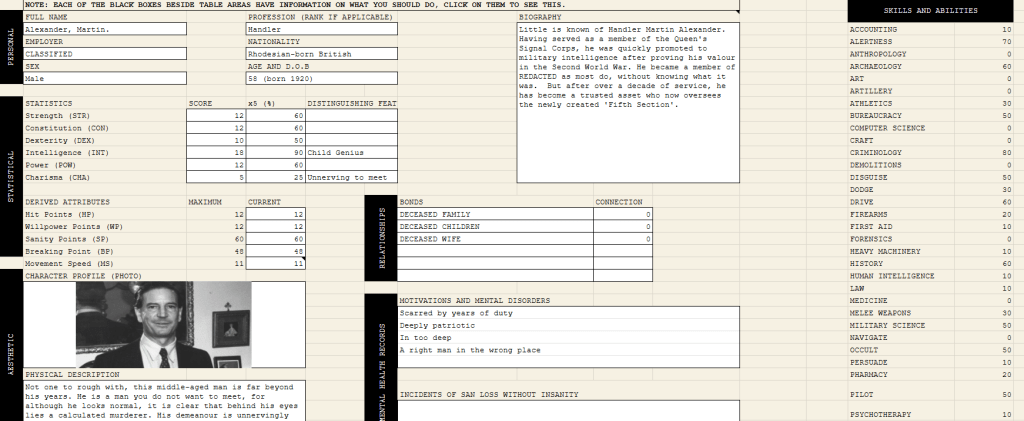
City of God really came into existence in early March 2023. This was quite a crude bit of game design as I was bouncing half-baked ideas off the wall with my friends through a couple of early playtests. This process was necessary to gain a perspective on what it was that I was trying to make, and to not get too tunnel-visioned on a particular kind of mechanic. I’d sit at home tearing out my hair (what’s left of it) trying to figure out how a particular mechanic would work in the context of the game. This was exacerbated by the fact that, as a relative newcomer to TTRPGs, I didn’t really understand what made tabletop games work, or how or why certain mechanics are good or some are bad.
For example, I’d become hyper-fixated on an action economy system to create a sense of horror, providing a tangible cost to even small player actions. But this didn’t really work as I’d intended, as people were more worried about their point allocation than roleplay immersion, which was ultimately my goal. So I spent the majority of my time between March and June 2023 researching tabletop games design, understanding how mechanics complement the intent of a game, what kind of systems work and which don’t, what ideas have been tried in tabletop games, and also some business elements like seeing how much physical production costs (turns out a lot, which is why City of God was released digitally).
I feel this early development process is really important because it’s basically your thinking time. It’s where you give yourself the space to imagine, dream, and research in a deep and fundamental way, so that when it comes to the later crunch time you’ve got some strong foundations to work from. How long this takes for people kind of depends on the scope of what you’re doing. City of God was always going to be a small game, and so I think the time I spent was about right.
I think research is really important and somewhat understated here. I spent a great deal of time researching some of the academic and cultural theory around horror, the Dark Ages, and investigative horror. Of note, I found three books pretty instrumental to my research.
The first of these was Umberto Eco’s The Name of the Rose, an early medieval murder mystery. This is discussed at length in the City of God introduction as the main inspiration for The Labyrinth story device. I won’t repeat myself here, but the basic idea is that investigative stories are scary because they have a looming sense of horror, while the perspective of the player (or protagonist) sees only a kind of descending labyrinth around them, leading towards one terrible destination (the centre, where the lurking horror awaits them). This is interesting from a kind of philosophy of play perspective as it helps bind exactly what you want to represent in a horror tabletop game, and why it’s important to keep those games focused.
The second of these that I haven’t ever really talked about is Mark Fisher’s The Weird and The Eerie. The Weird and the Eerie is a strange book. For those unaware, Mark Fisher was a post-Marxist political theorist and cultural philosopher who hanged himself in 2017. Written right before he died / published shortly after his death, he wrote this book. It’s best described as a treatise on horror. Fisher examines, through the lens of several cultural artifacts (such as Alfred Hitchcock films, folk lore, and horror stories) why and how humans feel fear, and in what contexts they do so. I won’t summarise the whole book, but I found his description of the eerie particularly compelling. In a quote that I think does justice of Fisher’s work:
“The core insight reveals the eerie as the trace of an impenetrable agency without, or some unnerving non-subjective drive that compels our behaviors incomprehensibly from within.”
Roger Luckhurst, Los Angeles Review of Books (2017)
What is this ‘trace of impenetrable agency’? Demons, of course. The whole existence of demons within this game is predicated upon the idea that there is a deep, terrifying, malignant force that exists outside of your control, that seeks to harm you and to destroy the things that you cherish. In City of God, these are the demons that players must exorcise.


Maturation (June-August 2023)
It’s after June that I get access to InDesign and City of God really starts to take shape. I haven’t really touched on style yet, so let me mention it here. I found in the dark corners of the internet, two artists that I really liked the work of. Pawell, and Rits. They’re really good guys and I’ve enjoyed working with them. Pawell, in particular, was instrumental to providing the kind of artistic critique that the book needed in its early inception. I come from a creative background but I’m quite unfamiliar with InDesign, so it was Pawell as creative director who really helped bring the book to a place where it needed to be. I also felt like his unique artstyle was sufficiently crazy enough to be perfect for a horror game. Rits was a great backup artist, and I was always impressed with the quality of the art that he produced. I also have Trin to thank, who I’ve known for several years, but has always been a rock of creative support to my little projects (this one was actually finished!)
It’s during this period that the mechanics really started to be fleshed out. I don’t know how I did it, but I think at a certain point I just said ‘f*** it’ and decided to stop over-thinking . You’ve got to make games that you want to play, and I just sat down every evening for a few months and really, deeply asked myself, was I making a game that I wanted to play. It was at this point that a lot of streamlining occurred. Not too much playtesting (I’ll come to that later) but it was done in the service of creating an internally coherent mechanical system, that made sense and could actually be played.
I don’t really know how to describe mechanics design. I guess I think of it like creating a spider or network diagram. Everything needs to connect to something, it needs to have a root to the same core idea or principle, and if you’re lucky you’ll end up making something that’s deceivingly simple and fun at the same time.
There’s nothing complex about City of God. But I suppose the real innovation, or the mechanic I’m most proud of, is the idea of your religious identity (Convictions and Sins) setting the course of your actions. Simply put, you gain points to cast prayers by acting a certain way. This is by no means original (Pendragon comes to mind), but I think it does a good job of representing the dilemmas of a religious exorcist in a way that mechanically makes sense in the context of the game. How else are you to banish demons, if God doesn’t love you?
Game Release (September-October 2023)
It was around September that I decided I had what I wanted to make my game. The lay-up into InDesign was now in full swing, and I had just opened my Kickstarter page. It was hard learning on the job a lot of social media etiquette, to ensure that people actually cared about the game that I was making. It was here that I started my Kickstarter, and my Twitter page started to enter the follower count of the hundreds.
In terms of the Kickstarter, I mean, none of this would’ve been possible without the amazing support of every single Kickstarter backer that I have. The fourty of you who donated to this project will have a close place in my heart, for believing in this one man’s little dream. So thank you, and I hope you’re still with me. Kickstarters present exceptional opportunities to build a lot of hype around something, but there is a real art to doing them right which I only really learned after the Kickstarter was over.
Although there’s huge advertising bonuses to getting your game reviewed, for me I was far more interested to get a bit of a litmus test on my game – to make sure I hadn’t made something bad or boring. MJRRPG was probably the most engaged reviewer I spoke with during this period. He even proposed some mechanics and amendments to the character sheets that I think ended up making it into the final edition of the game. Lots of love for this guy.
Another reviewer who joined this club of reviewers (but almost a year late) was Notepad Anon. He described described City of God as “having heart“. This was very cute to hear and has earned my lifelong affection of this guy. However, Notepad also rightly pointed out that “the premise is more interesting than the execution” of the game, which I don’t disagree with. City of God was, for me, a really good test of my game design skills, but I’m very eager to bring that to a new concept and see what else I can come up with. Notepad also has the added honour of being the first person to describe me as having “the most British sound name ever”, which I don’t think is an honour many people hold.
Post-Release (November 2023 – July 2024)
After finishing City of God I felt like a huge weight had been lifted from my shoulders. This is good, but it’s also bad. New companies, especially in the tabletop space, need to cultivate and engage with an audience – and I hadn’t really done anything to ensure the longevity of what I’d made. So I went silent on pretty much ever platform for almost a year while I was working on my own little projects and focusing on real-life commitments. From my perspective, City of God was complete, and I didn’t want to waste people’s times until I had something that they would actually be interested in hearing. What do you do when a game is released? Well, I guess you start working on other games. I’ve got about five or six projects on the go now, but none of them really reached where I wanted them to. I kept on finding myself jumping from one idea to the next, trying to find my next ‘City of God’.
I’d been in contact with an old friend of mine, Bryn Fox, who mentioned how much he loved City of God and wanted to write a Campaign Book for the game. When it was first mentioned to me I wasn’t really interested in doing more City of God, but I’m glad I persisted with it. Skimming over many details, over the course of the last months Spilled Ink Studios has been revitalised. With the small design team that’s been formed from City of God’s carcass, we’ve managed to put together a really impressive Campaign Book and a revamp (and well-needed re-write) of the Core Rulebook. It has been a pleasure and a real joy working with this new team (Bryn, Ben, and Rosa). I wouldn’t have done any of this without you, and so thank you for your support.
Lessons Learned
What was the point of City of God? To make a game, sure, but ultimately it was to identify key lessons of the tabletop industry that I can take into my next game. I’m hoping that the lessons I’ve learned might be useful to whoever else is reading this, and thinking about designing their own game. To dissect these in no particular order:
- Design a game you want to play
- Ultimately, you will only make a good game if it’s the kind of game you yourself would want to play. This should be fairly obvious but I think as a designer you can often get stuck down a particular rabbit hole that is engrossing everything you can see. The classic idiom here is that you can’t see the wood for the trees. I think that applies tenfold in games design. Always keep your eye on the bigger picture.
- Ultimately, you will only make a good game if it’s the kind of game you yourself would want to play. This should be fairly obvious but I think as a designer you can often get stuck down a particular rabbit hole that is engrossing everything you can see. The classic idiom here is that you can’t see the wood for the trees. I think that applies tenfold in games design. Always keep your eye on the bigger picture.
- Playtest, Playtest, Playtest.
- You can never playtest a game too many times. It is an essential part of both the conceptual process, as well as the refining process of a game, to make sure what you’re making both (1) makes sense, (2) is fun, and (3) isn’t broken. This last one is deceptively challenging, especially the bigger you make your games.
- You can never playtest a game too many times. It is an essential part of both the conceptual process, as well as the refining process of a game, to make sure what you’re making both (1) makes sense, (2) is fun, and (3) isn’t broken. This last one is deceptively challenging, especially the bigger you make your games.
- Set realistic deadlines
- It’s important to not let your project fall by the wayside of other priorities. For me, I found a useful way to avoid this was to set self-imposed deadlines alongside my work schedule. Formal deadlines, such as Kickstarter launch dates, or dates you’ve publicly agreed to on social media, are I think a useful way to achieve this.
- It’s important to not let your project fall by the wayside of other priorities. For me, I found a useful way to avoid this was to set self-imposed deadlines alongside my work schedule. Formal deadlines, such as Kickstarter launch dates, or dates you’ve publicly agreed to on social media, are I think a useful way to achieve this.
- Be kind to your artists, and seek their advice
- My game wouldn’t have been possible without the creative input of the talented artist(s) that I was working alongside. So much of people’s interest in tabletop gaming just comes down to the visual presentation of your game. If you’re not an artist yourself, then you need to rely on the advice of those who really know what they’re talking about. Give them the space to advise you, always pay them on time, and don’t undervalue their service. It’s so difficult to work out pricing for indie tabletop games design. I ended up in the red over City of God, but I consider the money spent to be well worth it to receive such exceptional artwork and advice throughout the design process.
- My game wouldn’t have been possible without the creative input of the talented artist(s) that I was working alongside. So much of people’s interest in tabletop gaming just comes down to the visual presentation of your game. If you’re not an artist yourself, then you need to rely on the advice of those who really know what they’re talking about. Give them the space to advise you, always pay them on time, and don’t undervalue their service. It’s so difficult to work out pricing for indie tabletop games design. I ended up in the red over City of God, but I consider the money spent to be well worth it to receive such exceptional artwork and advice throughout the design process.
- Build and grow a community
- It sounds a bit cheesy these days, but I genuinely wouldn’t have been able to complete City of God without the passionate support of my friends and those that I met while developing the game. The tabletop community at large is such a friendly, welcoming place, and I’m glad that there is so much positive energy about. When you join a Discord and say you’re developing a game, more often than not you’re going to be flooded with messages of ‘that’s so cool!, i’d love to have a look!’ etc. This is so encouraging when you’re a fledgling little nobody games designer, and I am so grateful to have had that experience.
- It sounds a bit cheesy these days, but I genuinely wouldn’t have been able to complete City of God without the passionate support of my friends and those that I met while developing the game. The tabletop community at large is such a friendly, welcoming place, and I’m glad that there is so much positive energy about. When you join a Discord and say you’re developing a game, more often than not you’re going to be flooded with messages of ‘that’s so cool!, i’d love to have a look!’ etc. This is so encouraging when you’re a fledgling little nobody games designer, and I am so grateful to have had that experience.
- Advertising is King
- It is absolutely necessary, fundamental even, for a game to have good presence on social media and via other forms of advertising. I was told by a close friend with experience of Kickstarter that “projects which don’t meet their funding goal in 48 hours are unlikely to ever succeed”, and I think I agree with this assessment. There are so many projects which live or die because of this, no matter their quality. I think this is why I set such a relatively low goal for City of God’s Kickstarter (£100), given that I was not investing significant time or resources into advertising. Anything more than that had a significant risk of failure, and this is a fate I’ve seen so many other Kickstarter TTRPGs suffer.
- Another thing to note here is that I think advertising has to be pretty authentic to get people’s attention. People who play games are wise to well-prepared, polished, meaningless fluff. What they really want is a game that just looks cool. But communicating that in a way that isn’t going to put them off is a challenge. I suppose my remedy, or my recommendation, is to ensure that you’re being honest and transparent while you’re making your game. People (understandably) want to feel like they’re part of something, and it’s nice to give them a glimpse of who you are, and why you love doing what you do.
Anyway, that’s probably enough words for one day. Feel free to get in touch if you like what you read here, or join our community Discord.
Until the next dev log…

 Spilled Ink Studios